Blog
The History of Diamond-Encrusted Smartphones

In 2006, a Swiss company called GoldVish set a Guinness World Record with a phone called Le Million: an 18-carat white gold body, 120 carats of top-grade diamonds, and a price tag that matched its name almost exactly. It wasn’t the first diamond-set phone, but it’s the moment the category announced itself — and two decades later, the phones look nothing like it, even when the diamonds are just as real.
Diamond-set phones didn’t begin with the smartphone at all — the earliest examples were diamond-encrusted feature phones from the mid-2000s, and the practice migrated to iPhones only after the App Store made the smartphone the object worth decorating. The line separating a genuinely diamond-set device from a “diamond-look” one has always been grading and disclosure, not the phone underneath it.
How the Category Actually Unfolded
Vertu, already established in ultra-luxury handsets, offers a gold-and-diamond model priced around $90,000 — early proof that a phone could be sold as jewellery first and communication device second.
GoldVish releases Le Million: an 18-carat white gold body set with 120 carats of VVS-1 graded diamonds, priced at $1 million and recognized by Guinness World Records as the most expensive phone in existence.
GoldVish partners with watchmaker Frédéric Jouvenot on the Revolution, combining a detachable analog watch with pink and white gold and 29 carats of VVS-1 diamonds — luxury phone-making borrowing directly from horology.
British designer Stuart Hughes, working under his Goldstriker International brand, spends ten months building the iPhone 3GS Supreme: 271 grams of 22-carat gold and 136 diamonds set into the bezel.
Hughes follows it with the iPhone 4 Diamond Rose, encrusted with 500 diamonds totalling 100 carats — by this point, the iPhone itself had become the default canvas rather than a novelty choice.
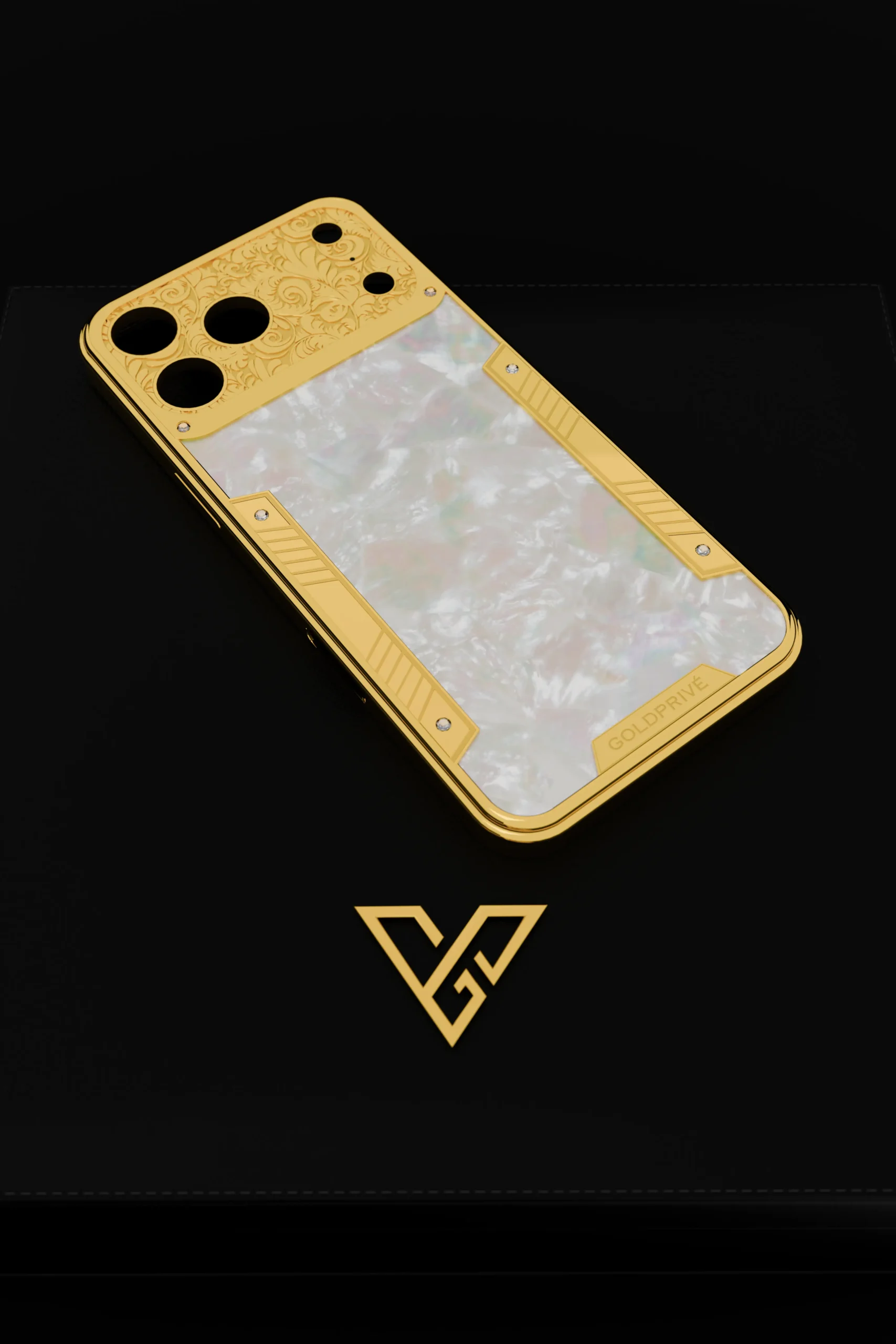
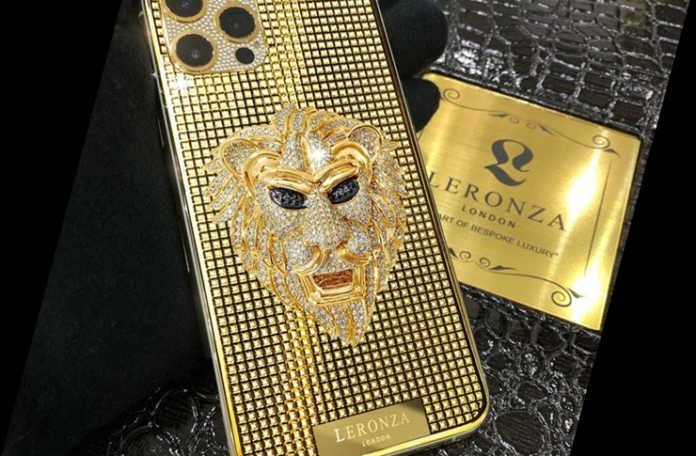
GoldPrivé introduces the Diamond Brilliance iPhone 11 Pro, setting clear white diamonds directly into the Apple logo with an accompanying certificate of authenticity, followed by a $500,000 solid 24K gold and diamond-encrusted Centurion iPhone 12 Pro — one of only three ever made, its lion motif set with hundreds of hand-selected diamonds.
Stuart Hughes passes away, and Goldstriker’s era of headline-grabbing diamond phone commissions effectively ends with him — a reminder that much of this category’s early history was built around individual craftsmen rather than standing companies.
Genuine diamond-grade luxury tech has broadened beyond phones entirely — GoldPrivé’s current catalogue, for instance, includes a MacBook Pro with a VS1-graded diamond-encrusted Apple logo, applying jewellery-grade certification to a laptop rather than a handset.
The Distinction the History Section Doesn’t Make Obvious
Reading through two decades of “diamond phone” headlines, one detail rarely gets separated out clearly: not every diamond-branded luxury device uses graded, natural diamonds. Simulated diamonds — typically cubic zirconia or similar lab-made stones cut to resemble diamonds — appear throughout the luxury accessory market, disclosed openly by reputable makers but easy to miss if you’re skimming a product name.
Graded Diamond
Carries a clarity grade (such as VS1 or VVS-1) from a recognized grading standard. GoldPrivé’s MacBook Pro Diamond Encrusted Apple Logo is specified at VS1 clarity, and the historical GoldVish models above were graded VVS-1.
Simulated Diamond
A diamond-look stone without a natural diamond clarity grade, generally used to achieve the visual effect at a lower cost. Several current luxury accessory pieces disclose this directly in the product name itself, such as items described as “simulated diamond” finishes.
Neither approach is dishonest when it’s disclosed — the problem only arises when a listing implies grading it doesn’t actually carry. The practical takeaway from the entire history above: the specific grading term used (or its absence) tells you more than the word “diamond” ever will on its own.
How These Phones Compare to Diamond Records Outside Tech
| Object | Year | Detail | Price / Record |
|---|---|---|---|
| GoldVish Le Million | 2006 | 120 carats, VVS-1, 18K white gold body | $1 million; Guinness World Record |
| Centurion iPhone 12 Pro | 2020 | Solid 24K gold, hundreds of diamonds, one of three | $500,000 commission |
| Graff Diamonds Hallucination watch | — | Multi-coloured diamonds, high jewellery watchmaking | $55 million |
| The Pink Star | 2013 sale | 59.60-carat Fancy Vivid Pink diamond, GIA graded | $83 million at auction |
Set side by side, it’s clear that even the most extravagant diamond phone still sits well below the ceiling set by fine jewellery and haute horlogerie — which says less about phones and more about how differently the diamond and jewellery markets value carat weight versus engineering.
Where Leronza’s Own History Fits
The 2019 Diamond Brilliance and 2020 Centurion commission mark two different approaches within the same house: one a catalogue-adjacent design applying diamonds to an existing Apple logo, the other a fully bespoke, solid-gold body built around a single client’s request. That same distinction — a numbered or catalogue piece versus a genuinely singular commission — is explored in more depth in what actually makes a device a genuine limited edition.
It also connects to a broader pattern worth reading directly: the shift from branded visibility toward verifiable, provenance-backed pieces discussed in why status symbols are changing. A diamond-set device is, in a sense, the oldest version of that idea — provenance and grading have always mattered more than the word “diamond” printed on a spec sheet.
If You’re Considering a Genuine Diamond Piece
- Ask specifically whether the stones are natural or simulated — both are legitimate, but the price and long-term value differ substantially.
- Ask for the clarity grade, not just confirmation that “diamonds” are used. VS1 and VVS-1 are meaningfully different tiers, and no grade at all usually signals a simulated stone.
- Ask whether a certificate of authenticity accompanies the piece, and what it actually documents — materials, carat count, or grading source.
- Weigh a numbered or catalogue design against a fully bespoke commission the same way Leronza’s own Diamond Brilliance and Centurion pieces differ from one another.
Questions From This History
What was the first diamond-encrusted phone?
Vertu’s gold-and-diamond models from around 2005 are among the earliest well-documented examples, predating the smartphone era entirely and setting the template that later diamond-set iPhones would follow.
Why did GoldVish’s Le Million get a Guinness World Record?
It was recognized as the most expensive mobile phone in existence at the time of its 2006 release, based on its $1 million price and its 120 carats of VVS-1 graded diamonds set into an 18-carat white gold body.
Is Stuart Hughes still making diamond-encrusted phones?
No. Hughes, the designer behind several headline diamond iPhone commissions in the late 2000s and 2010s, passed away in 2024, and his Goldstriker International brand’s era of custom diamond phone work ended with him.
Are all “diamond” luxury phones set with real diamonds?
Not always, and reputable makers disclose this directly. Some devices carry graded natural diamonds with a stated clarity grade, while others use simulated diamonds for a similar visual effect at a different price point — the product description should specify which.
How does GoldPrivé’s Centurion iPhone compare to historical diamond phones like GoldVish’s?
Both represent extreme ends of bespoke diamond craftsmanship, though the Centurion was built as a one-of-three commission around a solid 24K gold body with hundreds of hand-selected diamonds, rather than a repeatable catalogue model.
What does a VS1 diamond grade actually mean?
VS1 (Very Slightly Included 1) is a diamond clarity grade indicating minor inclusions that are difficult to see under magnification, sitting a tier above VS2 and below the VVS grades referenced in several historical diamond phones like GoldVish’s models.
Do diamond-encrusted devices hold value the way loose diamonds or fine jewellery do?
Not directly, since a device’s value combines the diamonds, the metal, the craftsmanship, and the underlying electronics, none of which necessarily appreciate the way a graded, unmounted diamond can on the open market.
Twenty years on from Le Million, the diamond phone hasn’t disappeared so much as it’s split in two directions: mass-market “diamond-style” accessories using simulated stones, and a much smaller lineage of graded, documented, genuinely rare pieces that trace a fairly direct line back to that 2006 record-setter.
See where genuine diamond craftsmanship appears across Leronza’s current pieces.
Explore the Collection